
Travel is one of the most researched categories online because the purchase decision is rarely instant. People compare destinations, check itineraries, read reviews, and evaluate pricing across multiple options before they ever speak to an agent. On mobile, that decision-making happens even faster, which means clarity and speed matter more than ever.
In this environment, your website is not a brochure. It is the system that earns trust, answers objections, and turns interest into inquiries or bookings.
Travel website development is the process of designing and building a booking-focused digital platform for travel agencies, tour operators, DMCs, and hospitality brands. It goes beyond visual design and includes itinerary structure, conversion pathways, SEO architecture, payment workflows, mobile usability, and performance optimization.
This guide explains how professional travel websites are built, what features actually drive bookings, how booking systems work, how travel website development costs typically change by scope in India, and how to choose the right development approach for long-term growth.
Quick Overview
- Travel website development focuses on building a structured, booking-ready platform for agencies and tour operators.
- A high-performing travel website is organized around destinations and packages, not just visual design.
- Clear itinerary layouts, transparent pricing, and visible inquiry or booking actions directly influence conversions.
- Booking systems can range from simple inquiry workflows to API-based travel portal integrations.
- SEO architecture must connect destinations, packages, and guides to build long-term organic visibility.
- Development cost depends on scope, integrations, and the depth of your destination and package structure.
- Mobile performance and page speed significantly impact user engagement and booking rates.
Who This Guide Is For
This guide is designed for:
• Travel agencies looking to improve inquiries and bookings
• Tour operators offering fixed or customized itineraries
• Destination management companies managing regional packages
• Hospitality brands expanding into tour-based experiences
• Travel businesses planning a website redesign or booking upgrade
If your goal is to turn website visitors into confirmed bookings rather than just display information, this guide will give you the structural clarity you need.
What Travel Website Development Means
Travel website development is the process of building a structured digital platform that helps people discover destinations, evaluate packages, and move smoothly toward an inquiry or booking. It is designed specifically for travel agencies, tour operators, DMCs, and hospitality brands that sell experiences.
Unlike generic websites, a travel booking website must handle both content depth and booking intent. It needs to present multi-day itineraries clearly, build trust quickly, and make the next step obvious on every package page.
In practical terms, travel website development usually includes:
- A destination and package structure that is easy to browse
- Package pages with day-wise itineraries, inclusions, and FAQs
- Inquiry and booking workflows, including WhatsApp and call actions
- Payment gateway integration if you accept online payments
- SEO-ready architecture for destinations and packages
- Fast mobile performance and optimized media handling
For tour operator website development, the goal is not only to look good. The goal is to reduce confusion, increase confidence, and turn browsing into action.
Why Travel Websites Require a Specialized Approach
Many businesses assume that any web development company can build a travel website. In reality, travel is one of the most complex service industries to structure digitally.
Information depth and clarity
A travel package often includes day-wise plans, accommodation details, transportation notes, pricing variations, and exclusions. Presenting this clearly requires thoughtful layout and hierarchy.
Decision sensitivity
Travel involves money, safety, and expectations. Users are cautious. Your website must build trust through structured content, testimonials, reviews, and transparency.
Multi-channel inquiries
Some customers want instant booking. Others prefer WhatsApp, phone calls, or customized inquiries. A travel agency website development strategy must accommodate all these behaviours.
Competition in search engines
Destinations and packages are highly competitive in search results. Without proper travel website SEO architecture, even the best-looking website struggles to generate organic traffic.
A custom travel website built specifically for the travel industry solves these challenges from the ground up.
What separates a travel-ready website from a generic website
A generic website can look premium and still fail for travel. Travel websites need structured pages that support comparison. They need clear itinerary layouts, visible actions on every package page, and SEO architecture that connects destinations, packages, and guides. When these elements are missing, the website may look impressive, but it will struggle to generate consistent inquiries from search traffic.
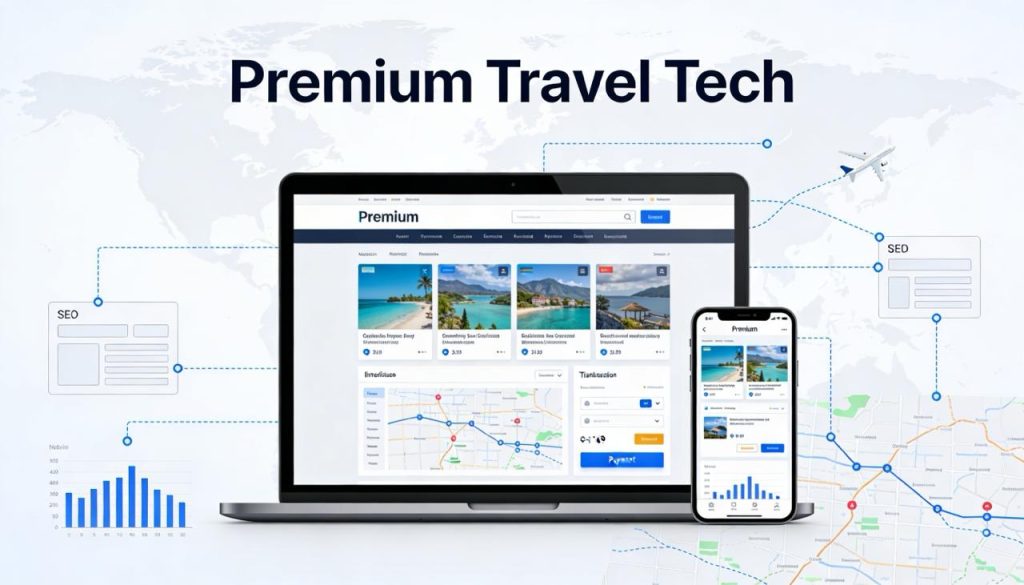
Core Structure of a High-Performing Travel Website
The structure of your travel website determines how users move through it and how search engines understand it.
Homepage built for direction, not decoration
The homepage should immediately clarify your primary destinations, top packages, and main action. It must guide users toward destinations or popular categories rather than overwhelm them with visuals.
Destination Pages
Each destination must have its own page. A well-structured travel website design organizes destinations in tiers such as country, region, and city. This helps both users and search engines understand relevance.
Example structure
/kashmir-tours/
/kashmir-tours/srinagar/
/kashmir-tours/7-day-srinagar-gulmarg-package/
This layered approach strengthens travel website SEO and improves crawl clarity.
Package pages designed for conversion
Every travel booking website must treat package pages as conversion assets.
A strong package page includes:
• Clear pricing presentation
• Day-wise itinerary in readable format
• Inclusions and exclusions
• Accommodation details
• High-quality images
• Frequently asked questions
• Visible inquiry or booking button
The design should reduce confusion. When users understand the offer clearly, they convert faster.
Example of a Well-Structured Itinerary Layout
Instead of presenting a long paragraph of daily activities, structure itineraries like this:
Day 1
Arrival and local sightseeing
Short overview of activities
Hotel check-in details
Day 2
Full-day excursion
Highlight major attractions
Mention travel time and inclusions
Day 3
Leisure or departure details
This format improves readability and keeps users engaged. Clear formatting increases time spent on the page and reduces confusion, which directly influences inquiry rates.
About and trust signals
Trust is central in travel website development. License numbers, company background, testimonials, and real photos create credibility.
Contact and inquiry systems
Forms should be short and mobile-friendly. WhatsApp integration and click-to-call options increase response rates.
Travel Website Features That Directly Impact Bookings
Not every feature improves performance. The following features contribute directly to conversions.
| Feature | Why It Matters | Priority |
| Structured itinerary display | Improves clarity and engagement | High |
| Mobile responsiveness | Majority of users browse on mobile | High |
| Fast loading speed | Reduces bounce rate | High |
| Payment gateway integration | Enables instant bookings | High |
| Advanced filters | Helps users find relevant packages | Medium |
| Review integration | Builds trust | High |
| FAQ schema | Improves search visibility | Medium |
| Blog section | Supports SEO growth | Medium |
These features should be prioritized during travel website development planning.
Understanding Booking Engine Integration and Travel Portal Development
Travel portal development often includes booking functionality, but not every travel business needs the same type of system. The right setup depends on how you sell packages and how much you want to automate.
There are two common approaches.
Widget-Based Booking Systems
Widget-based systems are plug-and-play tools that you embed into your website. They are often used when you sell fixed packages or when you want a simple booking layer without heavy customization.
This approach is suitable when:
- You have set packages with limited variations
- You want quicker deployment
- You can manage inventory and confirmations manually or semi-manually
The trade-off is limited flexibility in user experience and page structure.
API-Based Booking Integration
API-based integration connects your website with supplier inventories or booking systems so pricing and availability can update dynamically. This is common in travel portal development where real-time inventory, automation, or multiple suppliers are involved.
This approach is suitable when:
- You need real-time availability or dynamic pricing
- You want automation for confirmations and booking management
- You plan to scale destinations, packages, or supplier connections
API integration requires stronger testing because failures can impact bookings and customer trust.
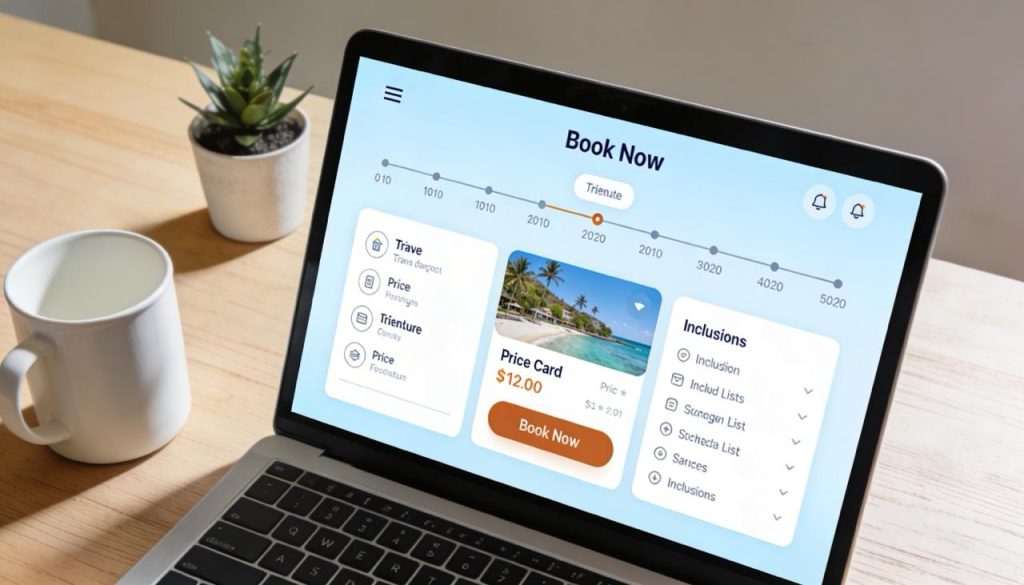
A practical hybrid model
Many agencies choose a hybrid setup. They use custom package pages for strong itinerary presentation and SEO, and integrate booking or payment only where it improves conversion. This keeps the site flexible while still enabling automation where it matters.
Travel Website SEO Architecture for Long-Term Growth
SEO for travel websites begins with structure.
Destination Clusters
Each primary destination should have a pillar page supported by sub-pages such as:
• Package listings
• Seasonal guides
• Travel tips
Internal linking between these pages strengthens topical relevance.
URL Hierarchy
Clean structure improves crawlability.
Example
/kashmir-tours/
/kashmir-tours/gulmarg-tour-package/
Content Depth
Destination pages should include meaningful information, not thin summaries. Adding travel tips, attractions, and practical advice increases authority.
Schema Markup
Implementing structured data such as FAQ schema, breadcrumb schema, organization schema, and service schema enhances search visibility.
Internal Linking Rules
• Destination pages link to related packages
• Packages link back to destinations
• Blog guides link to both
This creates a strong internal authority loop.
Travel Website Development Cost in India
Travel website development cost in India depends on the depth of your package content, the level of design customization, and whether you need booking engine integration or API connectivity.
Instead of thinking in one flat number, it is more useful to think in tiers based on functionality.
| Tier | What it typically includes | Best for |
| Starter | Basic design, destination and package pages, inquiry forms, WhatsApp and call actions | Small agencies starting online |
| Growth | Custom design, stronger SEO architecture, improved package UX, basic payment integration | Agencies focused on organic growth |
| Booking-Focused | Advanced filters, structured itineraries, conversion-led layout, CRM or lead routing, automated confirmations | Operators scaling inquiries and conversions |
| Portal-Level | Supplier API or booking engine integration, dynamic pricing, advanced inventory rules, multi-vendor logic | Large businesses building a travel portal |
What usually increases the cost the most:
- Booking engine integration and supplier APIs
- Large package inventory and frequent updates
- Advanced filtering and custom search logic
- Heavy media requirements without proper optimization planning
- SEO scope, especially destination cluster depth and content build
When evaluating professional travel website development services, it is crucial to align the scope with long-term scalability rather than prioritising short-term launch speed. A clear scope document and a defined content plan reduce rework and unexpected cost increases. In travel websites, rework often occurs when destination hierarchies and package structures are finalised after design, instead of before development begins.
Builder vs WordPress vs Custom Travel Website Development
Choosing the right approach depends on long-term goals.
| Platform | Advantages | Limitations |
| Website Builders | Quick setup | Limited scalability |
| WordPress | Flexible, SEO-friendly | Requires structured setup |
| Requires a structured setup | Full control and scalability | Higher investment |
For businesses targeting organic growth and advanced booking systems, flexibility and control often matter more than quick setup.
Travel Website Development Timeline
Travel website development should follow a structured process. Rushing development without planning usually leads to redesign within months.
A professional timeline typically includes the following stages.
1. Planning and Requirement Gathering
This is the most important phase and often the most ignored.
At this stage, you define:
• Target destinations
• Package structure
• Inquiry vs booking model
• Payment integration needs
• Content requirements
• SEO goals
For travel agencies, this phase should also clarify whether you need a simple inquiry-based system or a booking engine integration. Misalignment here causes delays later.
Clear documentation at this stage reduces scope creep and budget overruns.
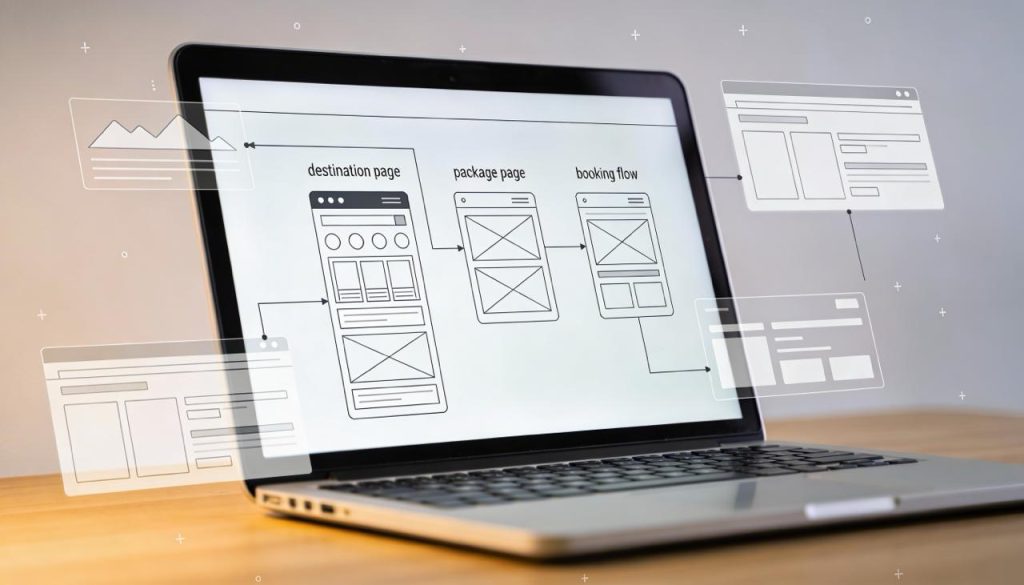
2. Wireframing and Content Structuring
Before design begins, the structure must be defined.
Wireframing focuses on:
• Homepage layout
• Destination hierarchy
• Package page format
• Itinerary presentation
• Placement of inquiry buttons
• Mobile layout priorities
At this stage, content flow is mapped logically. Destination pages link to packages. Packages link back to destinations. FAQs are planned in advance.
Good wireframing improves both user experience and travel website SEO.
3. Design and Development
This is where visual identity meets functionality.
Design must prioritize:
• Clarity over decoration
• Clean typography
• Easy-to-scan itineraries
• Visible calls to action
• Mobile-first structure
Development ensures:
• Secure coding practices
• Responsive behavior across devices
• Clean URL structure
• Scalable content management
Travel website design should not overload pages with animations or heavy visuals that reduce speed.
4. Integration and Testing
This stage includes:
• Payment gateway integration
• Booking engine setup
• WhatsApp and form integrations
• Email notification testing
• Security validation
Testing must be done across devices and browsers. Form submissions should be verified thoroughly. Broken inquiry systems directly reduce bookings.
5. Performance Optimization
Travel websites rely heavily on images. Optimization is critical.
This stage focuses on:
• Image compression
• Caching configuration
• Hosting performance
• Code cleanup
• Mobile speed testing
Slow websites lose users before they even read your packages.
6. Launch
Before going live:
• Final testing is performed
• SEO meta elements are checked
• Analytics tracking is installed
• Sitemap is prepared
After launch, continuous monitoring is required.
For travel portal development projects involving API integration or inventory systems, additional integration and validation time may be necessary.
Common Travel Website Mistakes That Reduce Bookings
Even professionally designed travel websites fail when structural mistakes are overlooked.
Below are the most common problems that directly reduce inquiry and booking rates.
Overcrowded Homepage
Many travel websites try to showcase everything at once. Multiple sliders, too many packages, and excessive animations create confusion.
A homepage should guide users toward clear next steps. Simplicity improves engagement.
Confusing Itinerary Layout
Long paragraphs describing daily activities without formatting discourage reading.
Users scan. Structured day-wise sections improve clarity and increase time on page.
Hidden Pricing
If pricing is unclear or buried in text, users hesitate. Transparent pricing builds trust.
Even if pricing varies, explaining the starting range improves confidence.
No Internal Linking Between Destinations and Packages
A destination page without links to related packages weakens both SEO and usability.
Internal linking helps users explore more options and strengthens topical authority in search engines.
Weak Mobile Performance
A large portion of travel traffic comes from mobile devices. Poor mobile layout, difficult navigation, or small fonts reduce conversions.
Mobile-first design is no longer optional.
Slow Loading Speed
High-resolution images, unoptimized code, and weak hosting reduce speed.
Even a few seconds of delay can increase bounce rate significantly.
No Structured SEO Planning
Launching a travel website without proper URL structure, meta titles, schema markup, and internal linking reduces long-term visibility.
SEO must be integrated during development, not added later.
Correcting these issues often leads to noticeable improvement in inquiry volume without increasing ad spend.

Pre-Launch Checklist for Travel Websites
Before launching your travel booking website, complete the following verification process.
Content Structure
• All destination pages are complete and meaningful
• Package pages include day-wise itineraries
• Inclusions and exclusions are clearly listed
• FAQs are present where needed
Booking and Inquiry Systems
• Payment gateways are tested successfully
• Confirmation emails are delivered correctly
• WhatsApp links open properly
• Phone numbers are clickable on mobile
Mobile and Speed Testing
• Website displays correctly on different screen sizes
• Fonts are readable on mobile
• Buttons are easy to tap
• Page speed is tested and optimized
SEO Setup
• Meta titles and descriptions are unique
• URL structure is clean
• Internal linking is verified
• XML sitemap is generated
• Robot configuration is checked
Schema Implementation
• Organization schema is added
• Service schema is implemented
• FAQ schema is structured correctly
• Breadcrumb schema reflects hierarchy
Analytics and Tracking
• Analytics tracking is installed
• Conversion tracking is configured
• Contact form submissions are monitored
This structured checklist prevents technical issues that commonly appear after launch and ensures that your travel website begins operating as a performance-driven asset from day one.
Final Thoughts
Travel website development is a strategic investment. It combines design, structure, SEO planning, and booking functionality into one cohesive system.
A well-built travel website is not just an online presence. It is a revenue engine that supports marketing, builds trust, and converts visitors into confirmed bookings.
When architecture, performance, and content depth align, your travel website becomes a long-term business asset.
Frequently Asked Questions
How much does it cost to build a travel website?
The cost depends on whether it’s an inquiry-based travel website or a booking-driven platform. Pricing increases with custom design, payment gateway setup, booking engine or API integrations, and the amount of destination and package content required.
How do I create a travel website that actually gets bookings?
Start with a clear structure for destinations and packages, add a scannable itinerary layout, and keep pricing easy to understand. Make inquiry or booking actions visible on every package page, ensure fast mobile performance, and build SEO pages for destinations and packages to attract organic traffic.
What features should a travel website include?
A strong travel website includes destination pages, package pages with day-wise itineraries, filters, inquiry or booking flow, WhatsApp and click-to-call buttons, reviews, and mobile-first performance. If you accept online payments, add payment gateway integration and automated confirmation messages.
How long does it take to develop a travel website?
A standard travel website can take a few weeks, depending on design complexity and how quickly package content is finalized. Travel portal development with booking engine integration or supplier APIs usually takes longer due to integration and testing.
Do travel websites need SEO?
Yes. Travel is highly competitive, and most bookings start with destination or package searches. A travel website should be built with clean URLs, internal linking between destinations and packages, and helpful content depth so Google can understand and rank it properly.
What is a travel booking engine, and do I need one?
A booking engine is the system that enables customers to check availability and place bookings, sometimes with online payment. If you manage bookings manually, an inquiry-first model can work. If you want automation, instant confirmations, or real-time inventory, you will likely need a booking engine or API integration.


